
What Is Variable Resistance Training?
A dumbbell weighs the same at the bottom of a press as at the top. A band does not. I anchored a Serious Steel® purple loop band to a crane scale and measured the force every 20 cm, so you can see the force curve with your own eyes.
Introduction
With a dumbbell, a barbell, or a cable stack, the number on the weight is what you lift the whole way. That is constant resistance (aka gravity).
A band works differently. Resistance comes from stretch, so the further you pull, the harder it pulls back. A band chest press is light at your chest and heaviest at lockout. A band squat is lightest in the hole and heaviest when you stand up. That is variable resistance.
The difference is where the work lands in the rep. Bands are lightest where your joints are most stretched and heaviest where you are strongest. That is why a lot of people find them easier on the joints.
It also explains the label. A loop band prints a range instead of one weight because stretch is the load. Same band, different length, different force.
How I measured it
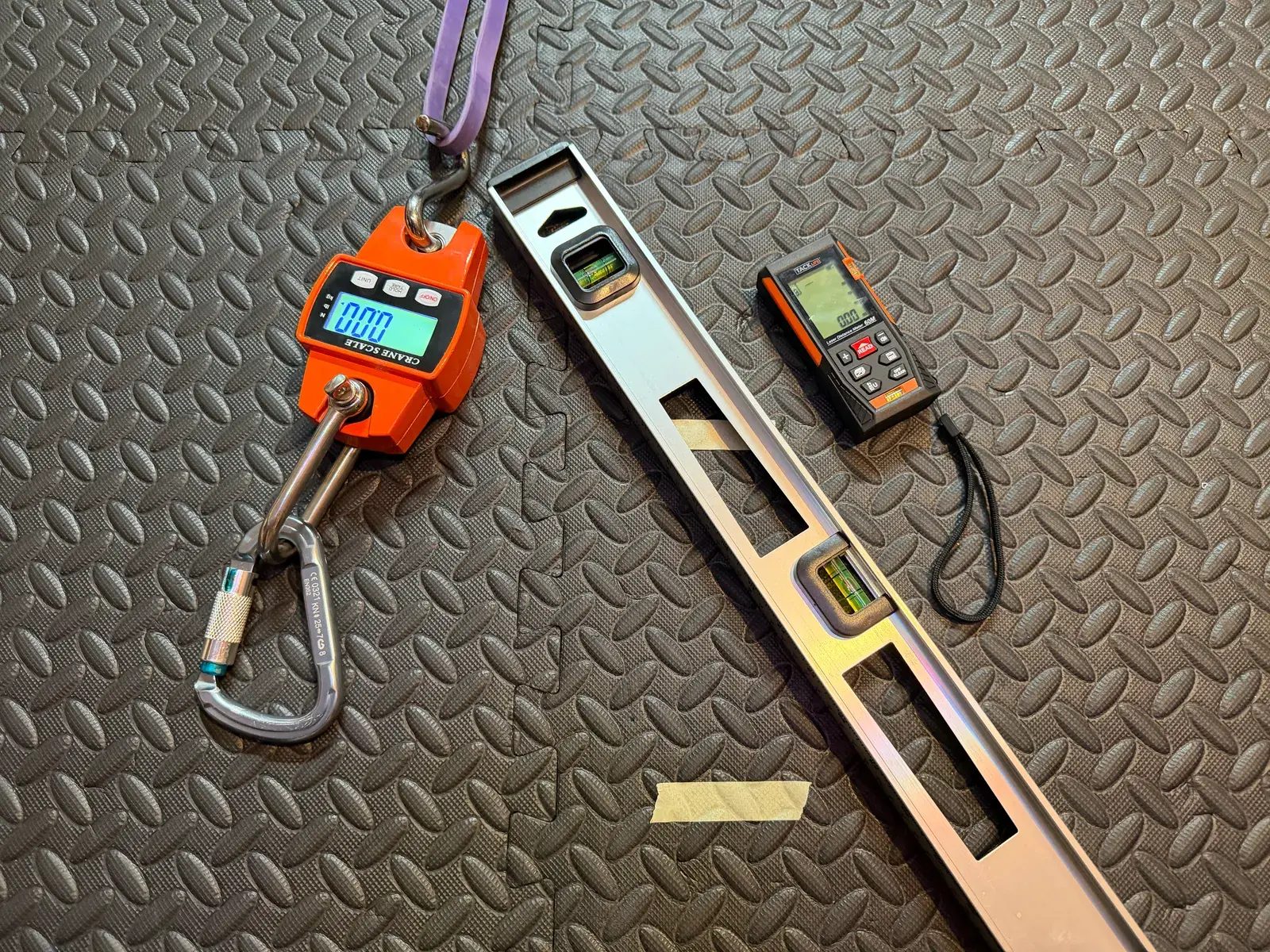
I anchored one end of a Serious Steel purple loop band and hooked the other to a digital crane scale. A laser distance meter helped me measure things.
I started at 1.33 m with a little bit of tension. So basically, the band end to end was 1.33 m. Then I added 20 cm at a time, and wrote down the force at each stop. Ten readings. Finished at 3.13 m.
I measured everything in metric even though I am based in the US because the laser reads out to 3 significant digits in metric. Nothing is smoothed or fitted. I did ten measurements and stopped at 3.13 m: a) I ran out of room, and b) the band was getting pretty hard to stretch by hand with my setup.
Band Force Curve
Single loop · stretch from 1.33 m in 20 cm steps · measured force production
Reading the curve
Every bar is taller than the one before it. More stretch, more force. That is the whole idea of a band.
The shape is the interesting part. A band fights hardest in the first few inches, while the slack comes out. Then it settles. Each extra centimeter costs about the same, and the curve turns into a long, nearly straight line. Near the end of what the latex can take, it stiffens hard again, right before it would tear. You do not want to train in that last section.
This test caught the first two parts. The first 20 cm added 2.10 kg, then each step settled to about 0.92 kg. In its working range the band is close to a plain spring: roughly 4.6 kg per meter of extra stretch, or 3.1 lb per foot.
Where the rest of the S would be
Ten readings only cover the middle of the curve. To sketch the rest, I fitted a standard rubber model from 1940 (Mooney). It sits within 0.06 kg of every reading, and it puts the band's resting length at 1.15 m.
That checks out. A new 41-inch band hangs about 1.04 m slack, and latex grows a little with use. So the first reading was only about 16% stretch. I cannot say where this band would break, so the chart marks the practical limits instead.
Three takeaways
- Force goes up. The jump does not. Total force still climbs every step, so the rep gets heavier toward lockout. After the first stretch, each extra 20 cm adds about the same amount.
- Stay inside the printed range. The label's 35 lb top lands at 3.9 m, about 3.4x rest length. Bands in use fail from a nick or fatigue long before the latex itself gives out. Treat anything past the label as failure territory.
- Stretch is the load. 2.4x the length gave 5.2x the force. A taller lifter, a wider grip, or a higher anchor all add stretch. Two people with the same band are rarely lifting the same weight.
What it means for training
On most presses and squats you are weakest at the bottom and strongest at lockout. A band matches that. You can push hard at the top without the bottom being limited by the heaviest weight you can get out of the hole.
Rows and curls flip it in a useful way. The hardest point is the squeeze, which is where you want the fight.
More importantly, it means you can get the same effective workout as a gym from your own home, while being gentler on your joints.
You skip the commute. You can attempt a hard set or a PR without a spotter, because there is no bar to get pinned under and nothing to drop on you. They are also quiet, so the session can happen before anyone else is up.
Common questions
Is variable resistance training better than lifting weights?
Not better or worse for building strength. A 2022 systematic review and meta-analysis of 17 studies and 491 adults (Andersen et al., Journal of Science and Medicine in Sport) found variable resistance training and traditional resistance training equally effective for improving maximal strength and muscle power. What changes is the feel of the rep. A band is heaviest at the top and lighter at the bottom. A weight is the same number the whole way. Pick the one you will actually do, and progress it.
Why is a resistance band's force curve shaped like an S?
A band fights hardest in the first few inches, while the slack comes out. After that, each extra centimeter costs about the same, so the middle of the curve is almost a straight line. Near the end of what the latex can take, it stiffens sharply again, right before it would tear. Those three parts make the S. A measurement of a Serious Steel purple loop band caught the steep start and the straight middle. It stopped short of 3 times the resting length, well before that last upturn.
How far can you safely stretch a resistance band?
Keep a band under about twice its resting length. Past that, the latex is running out of stretch, and repeating that is how nicks form and bands snap. Inspect bands for cuts before you use them. Anchor them to something that cannot slip or cut them. Move up to a heavier band instead of over-stretching a lighter one.
Use the bands you already have
Tell Rubber Bands which bands are in your bag. It builds the workout around them and progresses you from there. Free to try, no account required.
Learn more about Rubber Bands, the resistance band workout app.